
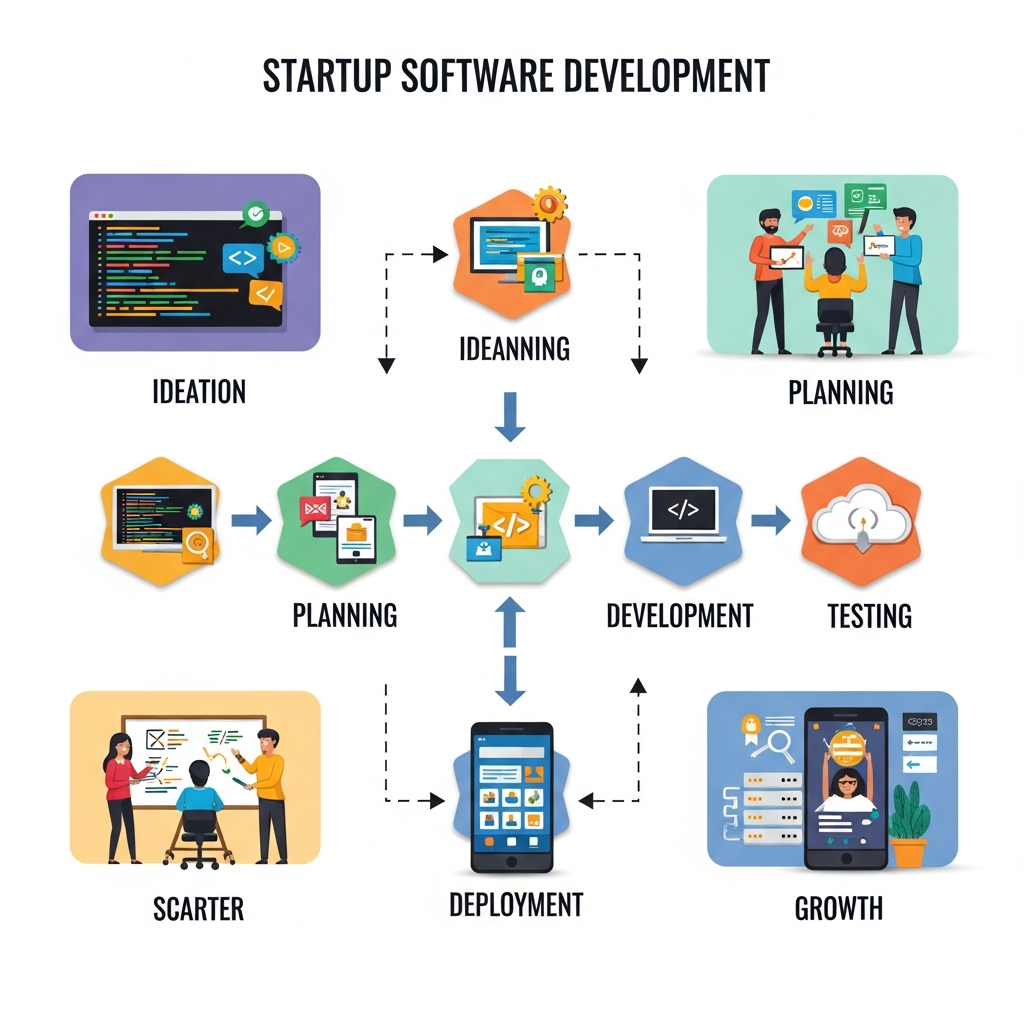
Startup Software development is the process of turning a new business idea into a working digital product, such as a mobile app, SaaS platform, marketplace, web application, internal tool, AI product, fintech solution, or customer-facing portal. Unlike traditional enterprise software projects, startup development usually happens under pressure: limited budget, uncertain market demand, small teams, tight timelines, and a need to learn quickly.
That is why the goal is not simply to “build an app.” The real goal is to build the right version of the right product for the right users at the right time. A startup can have beautiful design, clean code, and impressive features, but still fail if the product does not solve a meaningful problem or reach the right market.
This is where product validation becomes essential. CB Insights’ startup failure research highlights lack of product-market fit and running out of cash among major reasons startups fail, based on analysis of hundreds of startup post-mortems. That is a strong reminder that founders should not treat software development as only a technical activity; it is also a business discovery process. (CB Insights)
A smart development approach helps founders test assumptions before spending too much money. It helps answer practical questions: Do users actually need this? Which features matter most? Can the business model work? Is the product easy to use? Can the team build and maintain it? Can it scale later?
The best startup teams treat software as a learning engine. Every prototype, MVP, release, user interview, analytics report, and support ticket gives clues about what to improve next.
Why Startups Should Not Build Too Much Too Soon
One of the biggest startup mistakes is building a large product before proving that customers want it. Founders often feel excited about the full vision. They imagine dashboards, automations, integrations, admin panels, mobile apps, AI features, payment systems, social sharing, analytics, and advanced customization from day one. That enthusiasm is natural, but it can become expensive.
A better path is to start with a Minimum Viable Product, or MVP. Atlassian defines an MVP as the simplest version of a product that allows teams to validate ideas and gather feedback with minimal effort. The Agile Alliance also explains that an MVP is about collecting validated learning from customers with the least effort, not about launching a weak or careless product. (Atlassian)
An MVP should not be ugly, broken, or incomplete in the areas that matter. It should be focused. It should solve one clear problem for a specific user group. For example, a startup building scheduling software may not need advanced AI forecasting in version one. It may only need user accounts, calendar availability, booking links, email notifications, and simple payments. If users love that core workflow, the team can expand later.
Building too much too soon creates several risks. First, the startup spends more money before learning whether the market cares. Second, the product becomes harder to change. Third, the team may delay launch for months while competitors move faster. Fourth, users may feel overwhelmed by features they did not ask for. Software license audit Prevents Costly Compliance Risks
A leaner approach gives the team more room to adapt. Launch a focused product, measure real behavior, collect feedback, and improve. That cycle is often more valuable than trying to predict every feature in advance.
Core Stages of Startup Software Development
The first stage is discovery. This is where founders define the problem, target audience, business model, competitors, user pain points, and product goals. Discovery may include customer interviews, surveys, landing page tests, competitor research, prototype testing, and pricing validation. The purpose is to avoid building based only on assumptions.
The second stage is product planning. This includes deciding what the first version should include, what should wait, and what success will look like. Atlassian’s product planning guidance describes product planning as a way to prioritize ideas, align teams, and move from brainstorming to execution with clarity. For startups, this clarity is priceless because every feature consumes time and money. (Atlassian)
The third stage is UX and UI design. UX design focuses on how the product works, while UI design focuses on how it looks and feels. A startup product should make the core action easy. If users cannot understand the signup process, dashboard, checkout, search flow, or onboarding steps, they may leave before the product has a chance to prove its value.
The fourth stage is development. This is where engineers build the frontend, backend, database, APIs, integrations, authentication, admin tools, and infrastructure. Startups usually benefit from an agile development process because it allows the team to build in smaller cycles, review progress, and adjust based on feedback.
The fifth stage is testing. Testing should cover functionality, usability, performance, security, and compatibility across devices or browsers. Even an MVP should be stable enough for real users. Bugs are normal, but major failures during onboarding, payments, login, or core workflows can damage trust quickly.
The sixth stage is launch. A startup launch does not always mean a giant public announcement. It may begin with a private beta, early-access group, pilot customer, or small target market. The goal is to observe real usage and learn.
The final stage is iteration. After launch, the team improves the product based on analytics, feedback, support requests, conversion rates, retention, churn, and revenue. This is where startups often separate themselves from slow-moving competitors.
Choosing the Right Tech Stack and Architecture
A tech stack is the combination of programming languages, frameworks, databases, cloud services, APIs, and tools used to build the product. For a startup, the right stack should help the team move quickly without creating avoidable problems later.
There is no universal best stack. A simple content platform may need different technology than a real-time messaging app, AI workflow tool, healthcare platform, fintech dashboard, or marketplace. The best choice depends on product complexity, team skills, budget, expected traffic, security needs, integrations, and future roadmap.
Founders should avoid choosing technology only because it is trendy. A boring, proven stack that developers understand can be better than a fashionable stack that is hard to maintain. Speed matters, but maintainability matters too.
Cloud architecture is also important. AWS describes its Well-Architected Framework as a way to build secure, high-performing, resilient, and efficient infrastructure using pillars such as operational excellence, security, reliability, performance efficiency, cost optimization, and sustainability. For startups, these ideas are useful because poor infrastructure choices can become painful as the product grows. (Amazon Web Services, Inc.)
Google Cloud’s architecture guidance also notes that stateless architecture can improve reliability and scalability because applications can scale quickly with fewer local dependencies. This kind of thinking helps startups prepare for growth without overbuilding too early. (Google Cloud Documentation)
A practical startup architecture should balance today’s reality with tomorrow’s growth. You do not need enterprise-level complexity on day one, but you should avoid choices that make future scaling impossible. Clean code, modular design, strong APIs, good documentation, and sensible database structure can save a lot of trouble later.
Security and Quality Should Start Early
Many founders think security can wait until the product grows. That is risky. Security does not need to slow everything down, but basic protection should be part of the development process from the start.
NIST’s Secure Software Development Framework, SP 800-218, provides recommendations for reducing software vulnerability risk through secure development practices. The framework is designed to help organizations integrate security into the software development lifecycle instead of treating it as an afterthought. (NIST Computer Security Resource Center)
For startups, this means using secure authentication, protecting user data, validating inputs, managing secrets properly, updating dependencies, reviewing code, backing up data, and limiting access to sensitive systems. These steps may not sound exciting, but they protect the business and its users.
Quality also matters. Early users are often forgiving when a startup is honest and responsive, but they still expect the product to work. If the app crashes often, loses data, sends wrong notifications, or breaks payments, users may not return.
A good quality process includes automated tests, manual testing, code reviews, bug tracking, staging environments, monitoring, and release checklists. The process does not have to be heavy. It just needs to be consistent.
Security and quality are not only technical concerns. They affect brand trust, customer support, fundraising conversations, enterprise sales, and long-term growth. A startup with strong engineering habits from the beginning is easier to scale than one built on shortcuts.
Budgeting for Startup Software Development
Budgeting is one of the hardest parts of startup development. Founders want a clear number, but software cost depends on scope, complexity, design quality, team location, integrations, platforms, security requirements, and timeline.
The most important budgeting rule is to separate must-have features from nice-to-have features. Must-have features are required for the product to deliver its core value. Nice-to-have features may improve the experience but are not required for early validation.
A startup budget should also include more than coding. Design, product management, testing, cloud hosting, third-party tools, analytics, legal needs, app store accounts, maintenance, bug fixes, and post-launch improvements all cost money.
Founders should avoid spending the entire budget before launch. The first version will need changes. Users will request improvements. Bugs will appear. Marketing may reveal new needs. A smart budget leaves room for iteration.
Another important point is team structure. A startup may work with freelancers, an agency, an in-house team, a technical co-founder, or a hybrid model. Each option has trade-offs. Freelancers can be flexible but may require strong management. Agencies can provide a full team but may cost more. In-house teams create long-term ownership but require hiring time and payroll commitment.
The cheapest option is not always the safest. Poor development can lead to rewrites, security problems, missed launches, and investor concerns. The best value usually comes from a team that understands startup constraints and can build a focused product without unnecessary complexity.
Common Mistakes Startup Founders Should Avoid
The first mistake is feature creep. This happens when the product keeps expanding before launch. Every new feature sounds useful, but too many features can delay learning. A clear MVP scope keeps the team focused.
The second mistake is skipping user validation. Founders may assume they understand the market because they personally feel the problem. That is a starting point, not proof. Real users need to confirm the pain, value, and willingness to adopt or pay.
The third mistake is choosing the wrong development partner. A team that is good at corporate websites may not be right for a complex SaaS platform. A team that writes code but offers no product thinking may build exactly what was requested, even if the request is flawed.
The fourth mistake is ignoring analytics. A startup should track meaningful metrics from the beginning, such as activation, retention, conversion, churn, feature usage, and customer acquisition cost. Without analytics, founders rely too much on opinions.
The fifth mistake is underestimating maintenance. Software is never truly finished. It needs updates, bug fixes, dependency upgrades, security patches, performance improvements, and feature refinement.
The sixth mistake is building for scale too early. Overengineering can waste time and money. Startups need a system that can grow, but they do not need to design for millions of users before proving that the first thousand care.
The seventh mistake is not documenting decisions. Even small teams need basic documentation for architecture, APIs, deployment, credentials, product rules, and roadmap decisions. This becomes even more important when new developers join.
How to Build a Product Users Actually Want
A product users want usually starts with a painful problem. The founder should be able to explain who has the problem, how they solve it today, why current solutions are frustrating, and why the new product is meaningfully better.
The next step is narrowing the audience. “Everyone” is not a useful early market. A startup should begin with a clear user segment, such as independent fitness coaches, small accounting firms, warehouse managers, college tutors, local clinics, remote design teams, or e-commerce sellers. A focused audience makes product decisions easier.
Then the team should define the core user journey. What is the one thing users must be able to do successfully? Book an appointment? Send an invoice? Track inventory? Create a report? Match with a provider? Build a campaign? That core journey should be simple, reliable, and easy to understand.
After launch, feedback should be organized. Not every request deserves a feature. Some users ask for things that only matter to them. Others reveal patterns that affect many customers. The product team should look for repeated pain points, usage data, and business impact.
A good product roadmap balances customer feedback, business strategy, technical health, and market positioning. It should not become a random list of demands. The founder’s job is to listen carefully, then choose wisely.
Scaling After the MVP Startup Software Development
Once the MVP shows promise, the startup can begin scaling. Scaling does not only mean handling more traffic. It also means improving the product, strengthening operations, supporting more users, hiring better teams, and building reliable systems.
At this stage, startups may add advanced features, stronger admin tools, integrations, automation, billing improvements, customer support workflows, reporting dashboards, and mobile experiences. The product may also need better infrastructure, monitoring, logging, backups, and security reviews.
Scaling also requires technical debt management. Technical debt is the cost of shortcuts taken earlier. Some debt is normal in startups because speed matters. But if ignored too long, it can slow development, increase bugs, and make every new feature harder.
The team should schedule regular refactoring, dependency updates, performance reviews, and architecture improvements. This keeps the product healthy while still moving fast.
Customer support should also become more structured. Early founders may handle support personally, which is useful for learning. Later, the company may need help docs, chat support, ticketing systems, onboarding emails, and customer success processes.
The best startups do not abandon MVP thinking after launch. They keep learning, testing, and improving. The product becomes more powerful over time, but each new feature should still serve a clear purpose.
Conclusion Startup Software Development
Startup software development is not just about writing code. It is about turning uncertainty into learning, learning into product decisions, and product decisions into a business that can grow.
The strongest startups begin with a clear problem, a focused audience, and a lean MVP. They avoid building too much too early. They choose technology carefully, protect quality, consider security from the start, and use real user feedback to guide improvement.
A successful product does not need to be perfect on day one. It needs to be useful, reliable, and focused enough to prove whether the idea deserves more investment. From there, the team can improve features, strengthen architecture, expand the roadmap, and scale with confidence.
Used wisely, startup software development becomes more than a technical service. It becomes the engine that helps founders test ideas, serve customers, attract investment, and build something that can last.

