
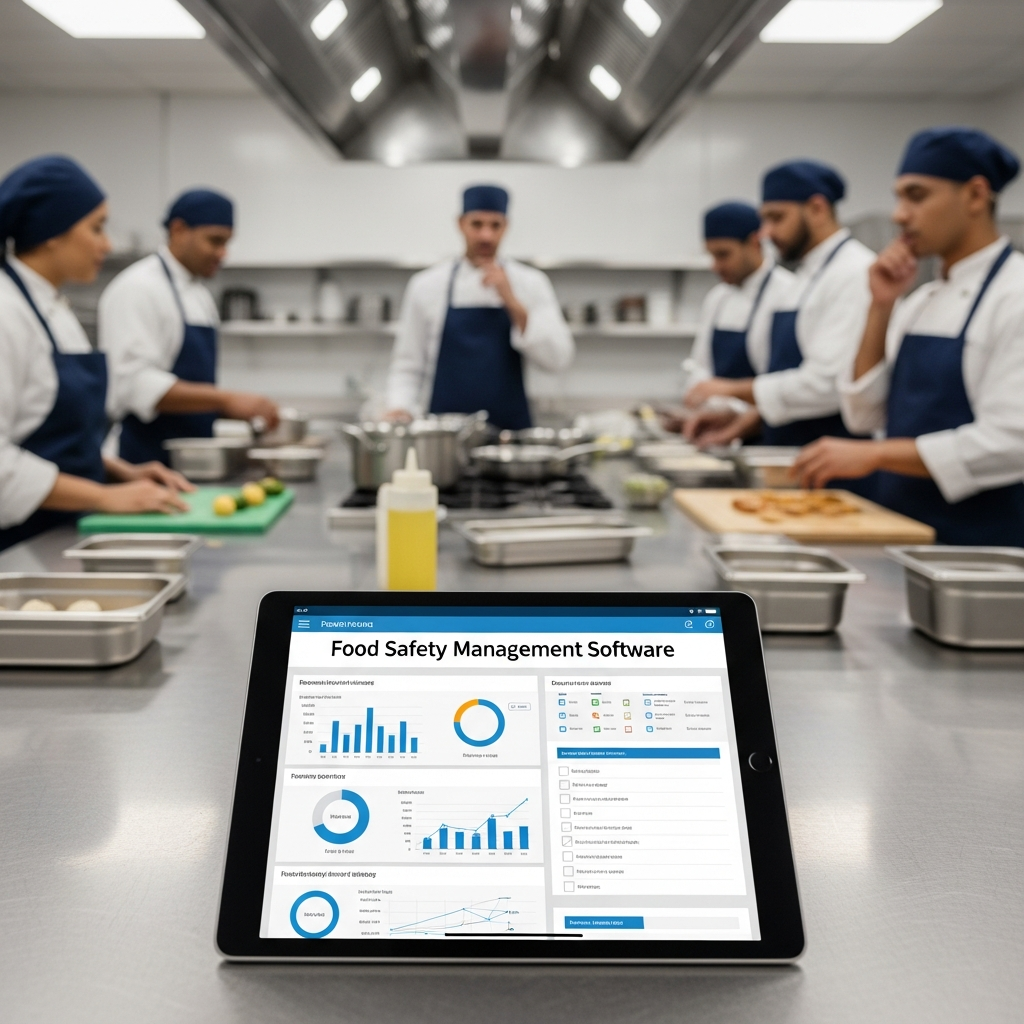
food safety management software is a digital system that helps food businesses manage safety processes, compliance records, audits, corrective actions, supplier controls, traceability, and quality documentation in one organized place. Instead of relying on paper checklists, scattered spreadsheets, binders, or memory-based routines, teams use software to record what happened, when it happened, who completed the task, and what action was taken next.
That matters because food safety is not a “set it and forget it” responsibility. When those records are hard to find, incomplete, or inconsistent, the business becomes vulnerable to audit failures, product holds, customer complaints, and serious safety risks.
The need is not theoretical. The CDC estimates that foodborne illness remains a major public health issue in the United States, with 48 million illnesses, 128,000 hospitalizations, and 3,000 deaths each year. (CDC) That single statistic explains why food companies are under pressure to move from reactive safety habits to preventive, documented, and verifiable systems.
At its best, the software becomes the backbone of a food safety culture. It gives managers visibility, gives employees clear tasks, and gives auditors confidence that the company knows its risks. In plain English, it helps everyone stop scrambling. Instead of hunting for a missing paper form before an inspection, a manager can pull up the record instantly. Instead of waiting until the end of the week to spot a missed temperature check, the system can flag it right away. That is where the real value shows up.
Food Safety Compliance and Digital Documentation
Food safety compliance depends on evidence. It is not enough to say that a hazard analysis was completed, a cooler was checked, or a corrective action was taken. A business needs accurate, time-stamped, reviewable records that show the process was followed. This is where digital documentation becomes a game changer.
In the United States, the FDA’s Food Safety Modernization Act is built around prevention. FDA explains that FSMA rules are designed to identify actions that must be taken across the supply chain to prevent contamination. (U.S. Food and Drug Administration) For human food facilities covered by the Preventive Controls rule, FDA states that facilities must have a food safety plan that includes hazard analysis and risk-based preventive controls. (U.S. Food and Drug Administration) Software supports this by keeping hazard analyses, preventive controls, monitoring logs, verification records, validation documents, and corrective actions organized and accessible.
The same logic applies to international food safety systems. ISO says ISO 22000 sets out requirements for a food safety management system and can be used by organizations of any size or position in the food chain. Its also describes ISO 22000 as integrating HACCP principles and Codex Alimentarius application steps. (ISO) A digital platform can help a business align its procedures, records, responsibilities, and improvement actions with these structured expectations.
One overlooked benefit is consistency. Paper systems often depend on individual habits. One employee writes “OK,” another writes a number, another forgets a signature, and someone else files the sheet in the wrong binder. Digital forms can require specific fields, standardize answers, attach photos, capture signatures, and prevent incomplete submissions. That does not automatically make a company compliant, but it does make compliance easier to prove and maintain.
Good software also supports internal audits. Managers can schedule audits, assign findings, track deadlines, and review recurring issues. Over time, the business can see patterns: repeated sanitation gaps, late supplier documents, temperature deviations, training delays, or allergen labeling risks. In other words, the system turns records into insight.
food safety management software for Traceability, Recalls, and Risk Control
Traceability is one of the strongest reasons to invest in food safety management software. When something goes wrong, time matters. A business must know which raw materials were used, which finished products were affected, where those products went, and which customers or locations need to be notified. Without a strong system, that process can become a stressful paper chase.
Modern software can connect supplier records, purchase orders, batch numbers, production dates, lot codes, inventory movements, shipping records, and customer destinations. This makes it much easier to trace ingredients forward and backward through the supply chain. In a recall or withdrawal scenario, that can reduce confusion and help the business act with confidence.
Risk control also includes allergen management. Allergens are one of the most sensitive areas in food operations because a small labeling mistake or cross-contact issue can cause serious harm. Software can help by storing approved labels, managing formulation changes, documenting cleaning verification, and flagging products that contain major allergens. For manufacturers with frequent product changes, that visibility is especially valuable.
Supplier management is another major piece. A food business is only as strong as the ingredients, packaging, transport, and services it depends on. A digital system can store supplier approvals, certificates of analysis, third-party audits, insurance documents, specifications, food safety questionnaires, and expiration dates. Rather than discovering that a supplier certificate expired months ago, the team can receive alerts before documents become outdated.
Corrective and preventive actions also become more disciplined. That creates a closed-loop process instead of a loose note in a binder.
The real win is not just faster recall readiness. It is better everyday risk control. The business can identify weak points earlier, respond faster, and create a more transparent record of responsible decision-making.
Operational Benefits for Food Teams
The biggest surprise for many teams is that software does not only help with audits. It also improves daily operations. Employees know what tasks are due. Managers know what has been completed. Quality teams know where the risks are. Senior leaders can see trends without waiting for someone to manually compile reports.
For frontline staff, digital checklists can make work simpler. A production employee might receive a sanitation checklist with clear steps. A warehouse worker might complete receiving checks on a tablet. A restaurant manager might log refrigeration temperatures from a mobile device. The system can guide the user through the process, require missing details, and send alerts when something is not right.
For supervisors, this saves time. Instead of chasing paperwork, they can review dashboards. Beside of guessing which location missed a task, they can see it. Instead of waiting for inspection day to discover a gap, they can act during the shift. That is a big deal because food safety problems rarely improve with delay. 7 Powerful Ways Employee Directory Software Improves
Another benefit is employee accountability. Digital records show who completed each task and when. This helps managers coach fairly because the conversation is based on evidence rather than assumption. It also helps recognize strong performers. When teams consistently complete checks, close corrective actions, and maintain clean records, that success becomes visible.
Training is also easier to manage. The software can track required courses, refresher training, role-based learning, policy acknowledgments, and competency checks. In food businesses with turnover, seasonal staff, or multiple locations, this can prevent training gaps from slipping through the cracks.
Finally, software supports continuous improvement. A well-managed system builds a history of data. Over months and years, leaders can spot repeated deviations, compare sites, measure supplier performance, review complaint trends, and prioritize investments. That turns food safety from a cost center into a smarter operating system for the business.
Choosing the Right Platform
The best platform is not always the one with the longest feature list. It is the one that fits the business’s real risks, team size, regulatory needs, and workflow. Before buying, a company should map its current process. What records are required? Which tasks are missed most often? What slows audits down? Which documents are hard to control? What would make life easier for frontline employees?
Important features include digital forms, mobile access, audit management, document control, corrective action tracking, supplier management, training records, traceability tools, reporting dashboards, electronic signatures, role-based permissions, and automated reminders. For manufacturers, batch and lot tracking may be essential. To restaurants, temperature logs and brand-level visibility may matter more. For distributors, receiving, storage, transport, and recall records may be the priority.
Ease of use should not be underestimated. If the system is clunky, employees will resist it. Else forms are too long, people may rush. If mobile access is weak, floor teams may avoid using it. A practical platform should make the right action easier than the wrong one.
Implementation should be phased. Start with the highest-risk or highest-friction process, such as temperature monitoring, sanitation checks, corrective actions, or supplier documents. Train a small group first, gather feedback, improve the workflow, and then expand. This approach prevents the “big bang” problem, where a company launches too much at once and overwhelms the team.
Businesses should also consider data security and record retention. Food safety records may contain sensitive supplier, customer, formulation, and compliance information. The vendor should provide clear information about access controls, backups, permissions, and export options. Ownership of data matters too. A company should know how to retrieve its records if it changes systems later.
The right food safety management software should feel less like an extra burden and more like a practical safety net. It should help people do the job correctly, prove what they did, and improve the system over time.
Conclusion Food safety management software
Food safety has always depended on discipline, documentation, and quick action. What has changed is the complexity of the modern food chain.
That is why digital systems have become so valuable. They help teams move away from scattered paperwork and toward a clearer, faster, more accountable way of working. From HACCP records and preventive controls to traceability, supplier approval, training, and corrective actions, the right platform can make food safety easier to manage and easier to prove.
In the end, food safety management software is not just about passing inspections. It is about protecting customers, strengthening trust, reducing risk, and giving food teams the confidence to do their best work every day.


