
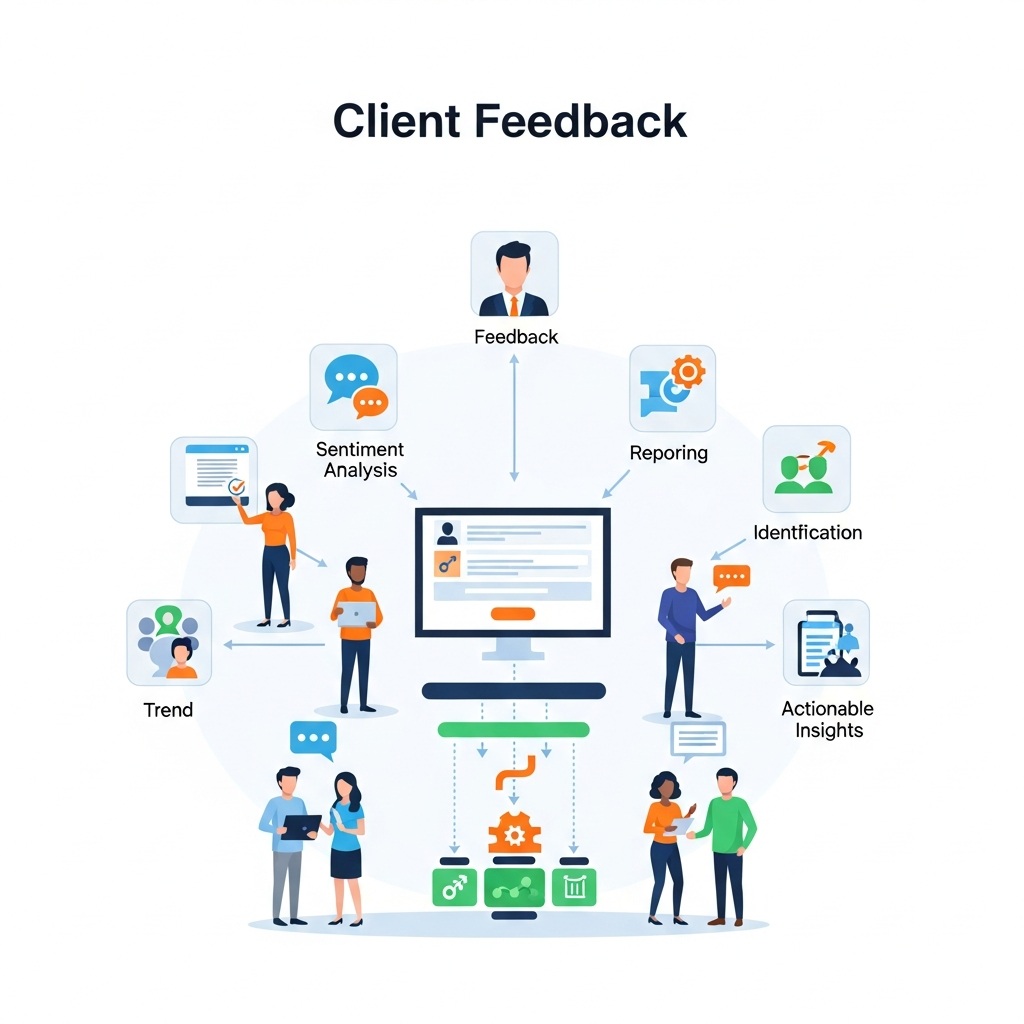
Client feedback software is a digital system that helps companies collect, organize, analyze, and act on opinions from customers or clients. Instead of relying on scattered emails, vague comments, or the occasional complaint, a business can use one platform to capture feedback through surveys, website forms, email prompts, SMS, chat, support tickets, QR codes, review requests, and in-app messages.
At its best, this software does much more than ask, “How did we do?” It connects feedback to real business decisions. A client’s complaint about onboarding can alert the customer success team. A low satisfaction score after a support ticket can trigger a follow-up. A repeated product request can be sent to the product team. In other words, feedback stops being background noise and starts becoming a clear roadmap.
Modern platforms often support common customer experience metrics such as NPS, CSAT, and CES. Bain describes Net Promoter Score as a loyalty metric used to understand how likely customers are to recommend a company, product, or service. (Bain) Zendesk explains that CSAT is commonly used to measure how satisfied customers are after an interaction, often with a simple rating and optional comment. (Zendesk Support)
The big win is speed. Without a proper system, feedback can sit unread for weeks. With the right platform, teams can spot patterns quickly: shipping delays, confusing invoices, weak onboarding, slow support, missing features, or even staff members who consistently delight clients. That’s gold dust for any business that wants to grow without guessing.
Why Businesses Need Smarter Feedback Systems
Clients rarely leave because of one tiny issue. More often, they leave because small frustrations pile up and nobody notices until it’s too late. A smart feedback system gives businesses an early warning signal. It helps teams see where friction is building before the relationship goes cold.
For service businesses, this is especially valuable. Agencies, consultants, SaaS companies, healthcare providers, financial firms, and B2B suppliers all rely on trust. When a client feels ignored, misunderstood, or undervalued, the relationship can take a hit. Feedback software makes it easier to listen consistently, not just when a client shouts loudly enough to get attention.
It also improves internal alignment. Sales may hear one thing, support another, and product something else entirely. A centralized feedback platform brings those signals into one place. That means leaders can compare comments, satisfaction scores, churn risk, renewal likelihood, and support history without playing detective.
Another major benefit is accountability. When feedback is tied to workflows, owners, and deadlines, teams can act instead of just observe. Qualtrics, for example, describes Voice of Customer software as a way to capture feedback across channels and route insights through workflows so teams can close the loop. (Qualtrics)
The result is a healthier customer experience. Teams stop arguing from opinion and start making decisions from evidence. That doesn’t mean every complaint becomes a project. Some feedback is one-off. Few comments are emotional. Some suggestions won’t fit the strategy. Still, when the same theme appears again and again, the business has a clear signal worth acting on.
Key Features to Look For
Good client feedback software should be easy for clients to use and practical for teams to manage. A beautiful dashboard means very little if nobody responds to the insights. Likewise, a powerful survey builder is wasted if surveys are too long, too frequent, or too confusing.
Start with feedback collection channels. A strong platform should support the places where your clients already interact with you: email, website, chat, support tickets, mobile app, SMS, and post-service surveys. For in-person businesses, QR codes and tablet-based surveys can be useful. For SaaS companies, in-app prompts and product usage triggers may be more valuable.
Next, look at measurement tools. NPS is useful for loyalty and recommendation intent. CSAT is helpful after a specific support or service interaction. CES measures how easy it was for a client to complete a task. Together, these scores give a fuller picture than one metric alone.
Text analysis is another must-have for growing teams. Open-ended comments often reveal the “why” behind the score. Sentiment analysis, keyword grouping, and theme detection help teams sort hundreds or thousands of responses without reading every line manually. That said, human review still matters. Automation can spot patterns, but people understand context.
Dashboards and reporting should be simple enough for managers and detailed enough for analysts. Look for trend tracking, segmentation, filtering by account type, export options, and alerts. Integrations are also crucial. If the platform connects with your CRM, help desk, project management system, or messaging tools, feedback becomes part of daily work instead of a separate chore.
Finally, privacy and access controls matter. Feedback may include names, contact details, complaints, contract concerns, health information, financial worries, or other sensitive data. The European Union’s GDPR sets requirements for collecting, storing, and managing personal data, and it can apply to organizations outside the EU when they target or process data from people in the EU. (European Union)
How to Choose the Right Platform
The best platform is not always the most expensive one. It’s the one your team will actually use. Before comparing vendors, define your purpose. Are you trying to reduce churn? Improve support? Measure account health? Refine your product roadmap? Increase reviews? Improve onboarding? Each goal requires slightly different features. Credit Management Software Creates Stronger Cash Flow
A small agency may only need simple surveys, email automation, and a clean reporting dashboard. A SaaS company may need in-app feedback, integrations with product analytics, customer health scoring, and ticket routing. An enterprise may require role-based permissions, advanced analytics, data residency options, single sign-on, multilingual surveys, and custom workflows.
Ease of use is huge. Clients should be able to respond in seconds. Teams should be able to build surveys without begging a developer for help. Leaders should be able to understand reports without needing a data science degree. If the software feels clunky during a trial, that friction probably won’t magically disappear later.
Also consider timing. Feedback is most useful when it’s collected close to the experience. A post-support survey should arrive after the issue is resolved. An onboarding survey should come after the client has had enough time to judge the process. A quarterly relationship survey should feel thoughtful, not random.
Budget matters, of course, but don’t judge only by monthly subscription cost. Look at implementation time, training needs, integrations, data migration, support quality, and reporting limits. Cheap software that creates messy data can become expensive in hidden ways. On the flip side, enterprise software with bells and whistles may be overkill for a lean team.
Before committing, test a real workflow. Build a survey, send it internally, review the report, create an alert, and assign a follow-up task. That little test often reveals more than a polished sales demo.
Best Practices for Turning Feedback Into Growth
Collecting feedback is easy. Acting on it is where the magic happens. The smartest businesses build a rhythm around listening, learning, and improving.
First, keep surveys short. Clients are busy, and nobody wants to wrestle with a 20-question form after a simple interaction. Ask only what you truly need to know. A rating, one open-ended question, and a relevant follow-up can often outperform a long survey packed with nice-to-have questions.
Second, close the loop. When a client gives negative feedback, acknowledge it. They suggest a useful improvement, thank them. When you make a change based on feedback, tell clients. This turns listening into trust. People are more likely to share honest input when they believe it won’t vanish into a black hole.
Third, separate urgent issues from strategic themes. A billing error may need immediate action. A repeated request for a new feature may need product planning. A trend of low onboarding scores may require process redesign. Not every piece of feedback deserves the same response, and that’s okay.
Fourth, segment your insights. Feedback from a new client may mean something different from feedback from a long-term account. Enterprise clients may have different expectations than small businesses. High-value clients may reveal retention risks earlier. Segmentation helps teams avoid broad conclusions from narrow data.
Fifth, combine feedback with behavior. A client who gives a low score and stops logging in is sending a strong signal. A client who gives a neutral score but continues expanding may need a different response. Feedback software becomes far more powerful when it connects with CRM, support, usage, and revenue data.
Lastly, create ownership. Someone should be responsible for reviewing trends, assigning follow-ups, and reporting outcomes. Otherwise, even the best client feedback software becomes a fancy suggestion box.
Conclusion Client Feedback Software
Client relationships grow stronger when businesses listen with intention. Feedback should not be treated as a once-a-year survey or a box-checking exercise. It should be part of how a company learns, improves, and earns loyalty every day.
The right platform helps teams capture honest opinions, understand trends, respond faster, and make better decisions. More importantly, it shows clients that their voices matter. And in a competitive market, that can be a real game-changer.
A strong feedback program does not need to be complicated. Start with clear goals, short surveys, smart timing, privacy-conscious data handling, and a commitment to action. Over time, those small listening habits can lead to better service, happier clients, stronger retention, and steady business growth.

